

The Advantage: Proven Hydrogen Economics
Real data showing why FARST leads in cost and carbon performance.
FARST combines advanced reforming and integrated carbon capture to deliver hydrogen that’s low-carbon, efficient, and consistently more economical than conventional blue technologies.
The FARST Advantage, Quantified: Real Performance, Proven Economics
A new generation of hydrogen reforming that delivers lowest Levelized Cost of Hydrogen (LCOH) while maintaining low-carbon intensity and scalable efficiency through integrated CO₂ capture and high thermal performance.
Advantage
Three pillars define the FARST Advantage – efficiency, capture, and performance, each contributing to the lowest achievable cost and carbon intensity in modern hydrogen production
System
FARST unites advanced reforming and pre-combustion CO₂ capture in a single high-efficiency cycle, reducing fuel use, plant complexity, and cost while delivering predictable economics and scalable low-carbon hydrogen at every project size.
Efficiency
Closed-loop heat recovery and integrated process design cut parasitic losses, flattening cost curves across variable gas prices. The result is lower LCOH, higher reliability, and durable operational stability for hydrogen and AI power applications.
Capture
Pre-combustion CO₂ capture eliminates solvents, producing a concentrated stream with >95% efficiency. High-temperature operation reduces OPEX and complexity, providing a clear emissions and performance edge over other hydrogen technologies.
Performance
FARST meets UK LCHS, EU low-carbon, and US 45V/45Q standards while maintaining lowest hydrogen cost and reliable delivery — ensuring bankable project economics, rapid deployment, and measurable climate-impact performance at scale.
Performance
Comparative Economics: How FARST Leads in Cost and Carbon Performance
Lowest production and delivery cost across every gas price scenario.
This table compares Levelized Cost of Hydrogen (LCOH) — the cost to produce — and bulk delivered price for leading blue and green hydrogen processes across gas prices from $0 to $16 /MMBtu.
FARST consistently achieves the lowest cost in both categories, maintaining wide margins even as fuel prices rise.
How much cheaper is FARST compared with other blue hydrogen technologies?
At typical North American gas prices of $4–$6 per MMBtu, FARST produces hydrogen for around $1 per kilogram — roughly 40% less than SMR, ATR, or GHR systems. Even as gas prices rise to $10–$12, FARST remains under $2/kg, while competing blue hydrogen processes reach $3/kg or more.
| Process - Volume | Gas Price $/MMBtu | |||||||
| $0.00 | $2.00 | $4.00 | $6.00 | $8.00 | $10.00 | $12.00 | $16.00 | |
| LCOH FARST 250tpd | 0.59 | 0.84 | 1.09 | 1.33 | 1.58 | 1.83 | 2.08 | 2.32 |
| LCOH FARST 500tpd | 0.44 | 0.69 | 0.94 | 1.18 | 1.43 | 1.68 | 1.93 | 2.18 |
| LCOH SMR 250tpd | 1.38 | 1.71 | 2.04 | 2.37 | 2.70 | 3.03 | 3.36 | 3.69 |
| LCOH e-SMR 250tpd | 1.80 | 2.09 | 2.38 | 2.67 | 2.96 | 3.25 | 3.54 | 3.83 |
| LCOH ATR 250tpd | 1.50 | 1.80 | 2.10 | 2.40 | 2.70 | 3.01 | 3.31 | 3.61 |
| LCOH GHR 500tpd | 1.27 | 1.55 | 1.83 | 2.11 | 2.40 | 2.68 | 2.97 | 3.25 |
| LCOH Shell BH2 500tpd | 1.17 | 1.49 | 1.74 | 1.99 | 2.24 | 2.49 | 2.75 | 3.00 |
| LCOH Unabated SMR 250tpd | 2.28 | 2.61 | 2.94 | 3.27 | 3.60 | 3.93 | 4.26 | 4.59 |
| LCOH Green H2 4 Usc/kWhe | 3.91 | 3.91 | 3.91 | 3.91 | 3.91 | 3.91 | 3.91 | 3.91 |
| LCOH Green H2 10 Usc/kWhe | 7.15 | 7.15 | 7.15 | 7.15 | 7.15 | 7.15 | 7.15 | 7.15 |
| SP bulk del FARST 250tpd | 2.99 | 3.24 | 3.49 | 3.73 | 3.98 | 4.23 | 4.48 | 4.72 |
| SP bulk del FARST 500tpd | 2.84 | 3.09 | 3.34 | 3.58 | 3.83 | 4.08 | 4.33 | 4.58 |
| SP bulk del SMR 250tpd | 3.78 | 4.11 | 4.44 | 4.77 | 5.10 | 5.43 | 5.76 | 6.09 |
| SP bulk del e-SMR 250tpd | 4.20 | 4.49 | 4.78 | 5.07 | 5.36 | 5.65 | 5.94 | 6.23 |
| SP bulk del ATR 250tpd | 3.90 | 4.20 | 4.50 | 4.80 | 5.10 | 5.41 | 5.71 | 6.01 |
| SP bulk del GHR 500tpd | 3.67 | 3.95 | 4.23 | 4.51 | 4.80 | 5.08 | 5.37 | 5.65 |
| SP bulk del Shell BH2 500tpd | 3.63 | 3.95 | 4.14 | 4.39 | 4.64 | 4.89 | 5.15 | 5.40 |
| SP bulk del Unabated SMR 250tpd | 4.68 | 5.01 | 5.34 | 5.67 | 6.00 | 6.33 | 6.66 | 6.99 |
| SP Green H2 4 Usc/kWhe | 6.31 | 6.31 | 6.31 | 6.31 | 6.31 | 6.31 | 6.31 | 6.31 |
| SP Green H2 10 Usc/kWhe | 9.55 | 9.55 | 9.55 | 9.55 | 9.55 | 9.55 | 9.55 | 9.55 |
Table 1: Levelised Cost of Hydrogen (LCOH) and Delivered Prices vs. Gas Price.
Why does FARST’s production cost stay lower than other blue hydrogen systems as gas prices rise?
FARST’s integrated reforming and pre-combustion capture process recycles heat efficiently and avoids solvent or oxygen-plant penalties. This design keeps production cost almost flat across gas price increases—from roughly $1/kg at $4 gas to under $2/kg at $10 gas—while SMR, ATR, and GHR climb to $3/kg or more.
- Gentler slope = lower sensitivity to gas volatility.
- Stable, bankable margins through the $6–$10 gas band.
- Lower CAPEX and parasitic loads than legacy blue routes.
FARST’s integrated reforming and capture cycle flattens the cost curve, sustaining efficiency and margins even as gas prices rise.
How does FARST maintain the lowest delivered hydrogen cost once logistics and distribution are included?
At $4 gas, FARST delivers hydrogen for ~$3.49/kg (250 tpd) and ~$3.34/kg (500 tpd), compared with $4.4–$4.8/kg for SMR and ATR. Even at $10 gas, FARST’s delivered cost stays at $4.1–$4.2/kg while others exceed $5/kg. Green hydrogen delivery remains $6.3–$9.5/kg even under favourable power prices.
- Production advantage survives delivery—still lowest at the gate.
- Scaling to 500 tpd tightens pricing further.
- Maintains >$1/kg gap vs. ATR/SMR at mid-range gas prices.
By maintaining process efficiency through compression and delivery, FARST remains the lowest-cost hydrogen supplier across every market scenario.
US Gas Price Sensitivity: LCOH & Delivered Cost
FARST’s curves remain the lowest—and flatter—across $0–$16/MMBtu.
This chart plots Levelized Cost of Hydrogen (LCOH) and SP bulk delivered under US gas-price assumptions for FARST (250/500 tpd) versus SMR, ATR, GHR, Shell BH₂, e-SMR, unabated SMR, and Green H₂ benchmarks. FARST sits below every blue alternative at each US price point, with a gentler slope signalling lower fuel-price exposure. The 500 tpd lines track beneath 250 tpd, confirming scale efficiency.
Scope & Assumptions
From the US gas curves, these four signals stand out.
- US gas prices: $0–$16/MMBtu
- Processes: FARST 250/500; SMR, ATR, GHR, Shell BH₂, e-SMR; Green H₂
- Metrics: LCOH and SP bulk delivered
- Note: 500 tpd line sits below 250 tpd (scale effect)
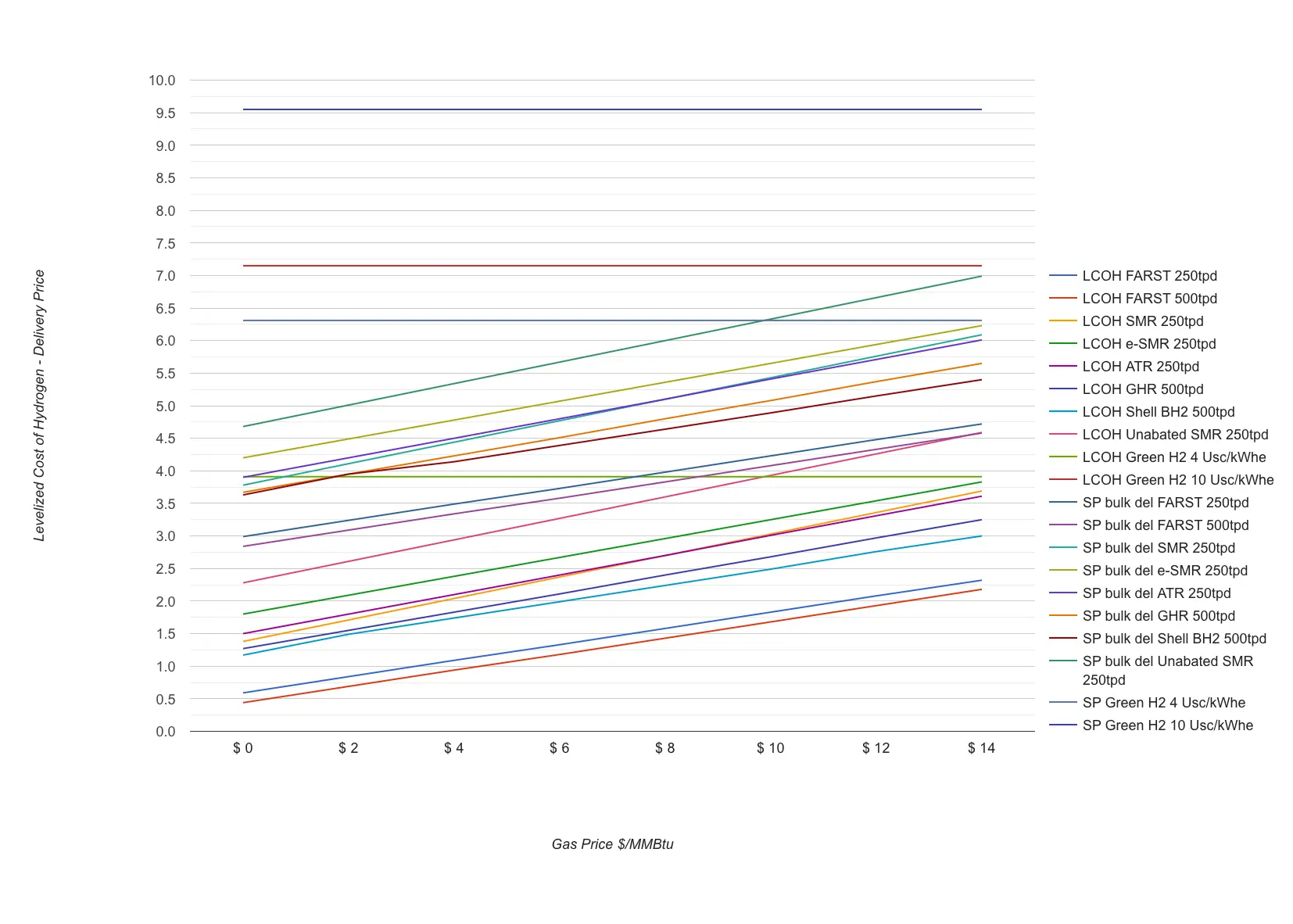
What do the cost curves indicate about FARST versus other blue and green hydrogen routes?
FARST holds the lowest LCOH and delivered price everywhere, with flatter slopes that preserve margins as prices rise.
- Consistently lowest costs for LCOH and delivered price across all US scenarios.
- Flatter curve than SMR/ATR/GHR → lower fuel-price sensitivity.
- Scale advantage: 500 tpd tracks below 250 tpd across the range.
FARST starts from a lower cost base and rises more slowly, preserving margin headroom as gas prices move higher
Does FARST maintain clear economic advantage at mid-range US gas prices, including six to ten dollars per MMBtu?
Yes; FARST typically keeps around forty-percent LCOH advantage over $1 delivered gaps versus SMR and ATR competitors.
- Mid-range strength at $6–$10 gas: clear LCOH and delivered gaps.
- Green comparison: even at 4–10¢/kWh, green H₂ remains above FARST.
- Bankability & credits: predictable curves support financing; 45V/45Q eligibility.
Stability underpins bankable project economics, reinforcing near-term competitiveness versus blue and green alternatives.
Technology Positioning: Where FARST Leads
Side-by-side comparison of blue hydrogen routes (FARST, SMR, ATR, GHR) versus Grey SMR and Offshore-wind Green H₂.
This matrix compares process complexity, catalyst, capture method, CAPEX, LCOH by gas price, and carbon footprint. FARST’s fluidised-bed reforming with integrated, pre-combustion CO₂ capture avoids solvents and oxygen plants, uses non-platinum catalysts, and delivers the best cost–carbon balance: lowest CAPEX among blue options, lowest LCOH across US gas prices, and compliant carbon intensity while grey SMR has low CAPEX but high emissions, and offshore-wind Green H₂ has near-zero carbon at substantially higher cost.
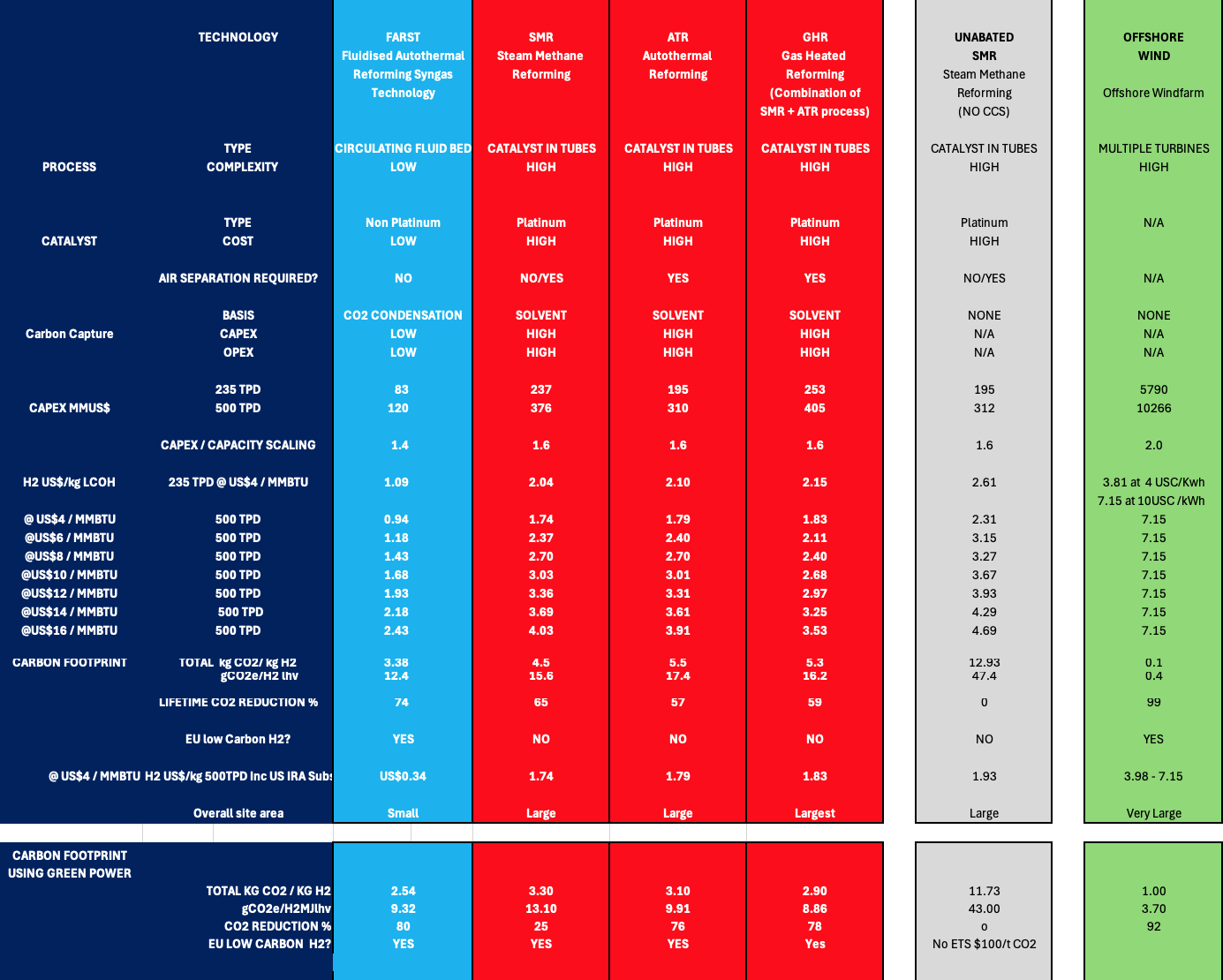
Table Highlights
- Process & complexity: FARST is a compact, integrated reformer with low auxiliary load; ATR/GHR/SMR rely on high-temperature tube reactors plus ASU and solvent loops, increasing complexity and parasitic load.
- Catalyst: FARST uses non-platinum catalysts; ATR/SMR/GHR typically require platinum-group catalysts, raising capital and replacement costs.
- Capture system: FARST is pre-combustion (no amine/solvent loop); ATR/SMR/GHR rely on solvent-based capture with energy and maintenance penalties; Grey SMR has no capture; Green H₂ is N/A.
- CAPEX: FARST shows materially lower CAPEX than ATR/GHR at 500 tpd (and scales well); grey SMR can be inexpensive but lacks decarbonisation.
- LCOH (cost): Across $0–$16/MMBtu US gas, FARST plots the lowest LCOH (and delivered cost). At representative prices ($4–$10), FARST ≈ $1/kg–<$2/kg, while ATR/SMR are typically $2–$3+/kg; Green H₂ benchmarks $3.9–$7.1/kg depending on power cost.
- Carbon footprint & compliance: FARST achieves deep reduction (≈ low-carbon thresholds), qualifying for US 45V/45Q and UK/EU low-carbon criteria; Grey SMR is high-emissions; Green H₂ is near-zero carbon but higher cost.
Analyst Q&A
Why does FARST land lowest on both CAPEX and LCOH among blue options?
Integrated reforming and pre-combustion capture eliminate solvent loops and ASU, reduce parasitic energy, avoid platinum catalysts, and compress plot area—cutting both capital intensity and operating cost.
How should this compare with Green H₂ from offshore wind?
Green H₂ offers near-zero emissions but remains significantly higher cost at today’s power prices. FARST provides certified low-carbon hydrogen with materially lower $/kg, making it the most economical path in the near term.
Applications
Where FARST Delivers Impact
FARST enables clean hydrogen and integrated carbon capture across the energy system. From electricity generation to heavy industry, transport, and digital infrastructure, FARST provides scalable low-carbon solutions wherever reliable energy is needed.

Power Generation & Fuel Cells
Producing clean electricity at scale through hydrogen-fired power plants, while supporting distributed fuel cell systems for industry and backup supply.

Transport Fuel Hubs & Energy
Multi-purpose FARST Hydrogen hubs that fuel trucks and fleets while also generating electricity for the grid and powering EV charging stations.

Co-Located AI Data Centres
Delivering clean hydrogen power and cooling for the growing energy demands of artificial intelligence and high-performance computing.

Steel Industry
Supplying hydrogen as a clean reducing agent to replace coal in steelmaking, cutting emissions in one of the most carbon-intensive sectors.

Fertilisers and Chemicals
Supporting ammonia and fertiliser production with low-carbon hydrogen feedstock, vital for agriculture and food security.

Cement Manufacturing
Providing clean hydrogen and integrated CO₂ capture for cement kilns, addressing both high energy demand and process emissions.
Partner with FARST to Accelerate Decarbonisation
Deploy compact, low-carbon hydrogen solutions across utilities, refuelling hubs, data centres, and industrial sites.
FARST enables cost-effective clean hydrogen production that integrates with existing energy networks and infrastructure.
Let’s discuss how we can collaborate to deliver real-world emissions reductions — today.